
Thanks for the Feedback: The 3 Triggers That Derail Feedback

We’ve actually got it backwards!
We expect managers and leaders to give feedback well. In fact, we rely on it! Organizations spend millions every year on performance evaluation systems and on the work hours committed to the process.
So, what do we get from this investment? According to Gallup and Deloitte:
- 2/3 of workers see it as “a complete waste of time”
- 3/4 of workers do not trust the process
- 85% of workers are left uninspired to improve or actively engage
- At least 1/3 of the time it is actually making performance worse
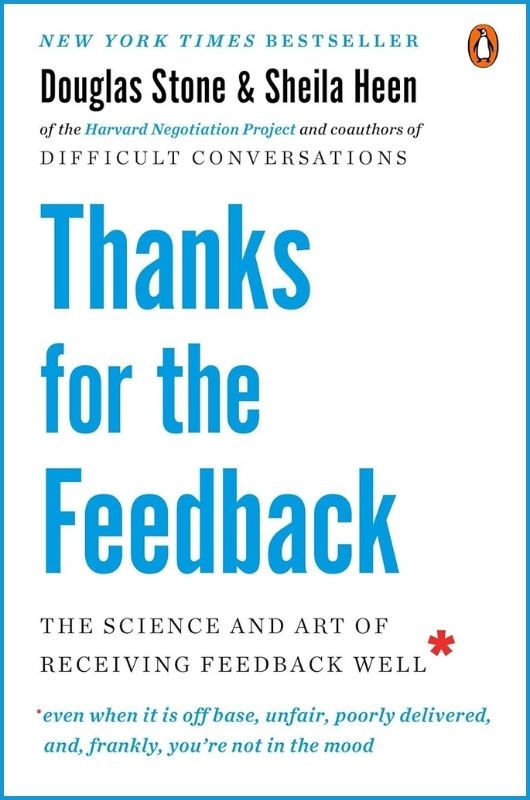
All of this drives us to double down on “how to give feedback well.” But look deeper, the data reflect a real issue Douglas Stone and Sheila Heen expose in their book, Thanks for the Feedback: The Science and Art of Receiving Feedback Well:
No matter how skillfully feedback is given, the receiver ultimately controls its effectiveness.
- Book: Thanks for the Feedback: The Science and Art of Receiving Feedback Well
- Authors: Douglas Stone and Sheila Heen
- Publisher: Penguin Books, 2014
This post contains affiliate links. If you purchase through these links, we may earn a commission at no extra cost to you. Doing so supports this website and our ability to bring you these book reviews and other content. We genuinely appreciate your support and take our responsibility to provide quality, honest, and human-generated content to professionals like you seriously.
What Thanks for the Feedback Offers: A Framework for Receiving Feedback Well
From their experience working with a wide range of people while writing their earlier book, Difficult Conversations: How to Discuss What Matters Most, Stone and Heen learned that feedback conversations are among the most difficult we have, for both givers and receivers, whether the feedback is positive or negative.
But more importantly, their studies revealed that the key player in this dynamic is the feedback receiver, not the feedback giver.
As long as we have self-agency, we will control how we receive feedback. And if we are serious about our own growth and improvement, our only choice is to get good at receiving feedback well.
But here is a twist, after reading Thanks for the Feedback multiple times over the last decade and reflecting on my own professional growth (success and mistakes), I believe:
You can’t get good at giving feedback well until you get better at receiving feedback well.
Feedback Triggers in the Workplace
Inevitably, when we receive feedback, we feel something: honored, confused, motivated, flustered… These feelings are responses to the feedback triggers: truth, relationship, and identity.
- Truth Triggers – The feedback feels wrong, unhelpful, or untrue. We focus on defending our position rather than understanding their perspective.
- Relationship Triggers – We react to who is giving the feedback rather than what they’re saying. Credibility, trust, or past interactions color our hearing.
- Identity Triggers – The feedback threatens how we see ourselves. Even when accurate, it shakes our sense of identity and competence.
Understanding these feedback triggers empowers us to manage ourselves and the feedback conversation more constructively.
This is how Thanks for the Feedback is organized: 2-3 chapters for each individual feedback trigger, with specific techniques for receiving feedback well and having better feedback conversations.
The Feedback Conversation
Stone and Heen want us to be better at recognizing feedback triggers so we can improve the feedback conversation.
A feedback conversation is a structured, two-way dialogue to discuss observed behaviors, performance, and development. For Stone and Heen, it is important for the receiver to be actively engaged in the conversation and to provide the giver feedback on the feedback.
They step through the feedback conversation, discussing how to navigate it as a receiver and how, when, and where to influence the feedback conversation.
We can only control one side of the feedback conversation, but that directly influences the other side of the conversation.
Why Thanks for the Feedback Matters for Today’s Leaders
While the book is generally oriented to personal feedback, it is also relevant to organizational and operational feedback loops.
We are constantly receiving feedback, as individuals, leaders, teams, projects, products, systems, and operations. And those feedback loops that took months now operate in days, even hours.
The ability to receive feedback well has become a competitive advantage: professionally, organizationally, and commercially. And since we can’t control the feedback giver, it all comes down to understanding our feedback triggers and having constructive feedback conversations.
Key Strategies for Receiving Feedback Well
The Three Types of Feedback
When someone gives us feedback, we immediately begin interpreting what we are hearing. Once we get our wires crossed, if what we are hearing is different than what is trying to be said, the crossed wires can be difficult to untangle.
So it is helpful to avoid crossing wires by validating what you are hearing; ”What I understand you to be saying is…”. Your goal is to ensure alignment around the intent of the feedback.
In Thanks for the Feedback, Stone and Heen illustrate that there are three basic types of feedback:
- Appreciation (thanks, I see you)
- Coaching (here’s how to improve)
- Evaluation (here’s where you stand)
Knowing the type of feedback being offered is crucial to receiving it well. The book walks us through recognizing the feedback being offered and influencing the feedback conversation to get the feedback we need.
Understand Your Feedback Triggers
The book’s most valuable contribution is helping us recognize which feedback trigger is being activated.
Truth triggers make us argue about facts. The antidote? Get curious about their perspective. Ask: “Help me understand what you’re seeing that I’m not seeing.” Separate their observation (data) from their interpretation (meaning) from their advice (what to do).