
Getting It Done: 5 Lateral Leadership Skills Everyone Must Master

You’re not always in charge, but you always need to be “getting it done”. And even when you are in charge, simply telling people what to do no longer cuts it.
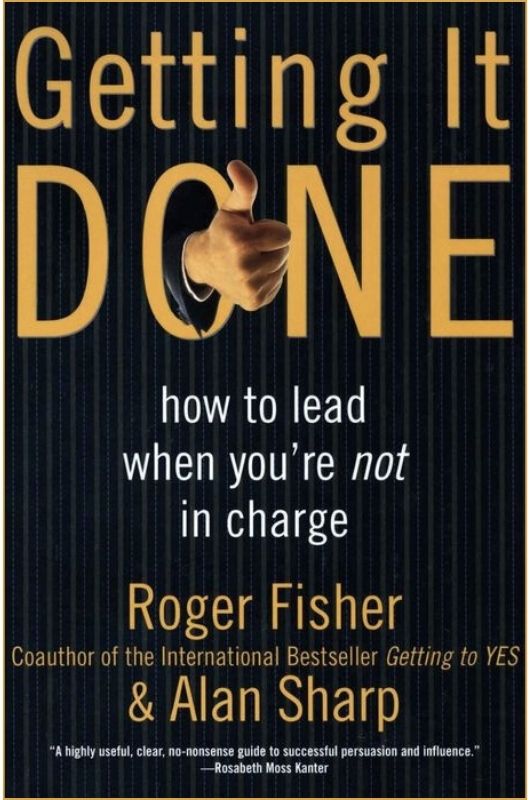
Roger Fisher and Alan Sharp understood this reality before Agile was cool. In Getting It Done: How to Lead When You’re Not in Charge, they provide a practical framework for lateral leadership skills to influence peers, engage stakeholders, and drive outcomes without formal authority. They show that in today’s collaborative work environments, these skills are essential.
But they don’t stop there; they also apply the very same principles and tactics to leading as the boss. After all, the gap between what needs to happen and getting it done has never been wider. Getting It Done provides the framework to close that gap.
- Book: Getting It Done: How to Lead When You’re Not in Charge
- Authors: Roger Fisher and Alan Sharp
- Publisher: HarperBusiness, 1998
This post contains affiliate links. If you purchase through these links, we may earn a commission at no extra cost to you. Doing so supports this website and our ability to bring you these book reviews and other content. We genuinely appreciate your support and take our responsibility to provide quality, honest, and human-generated content to professionals like you seriously.
What Getting It Done Offers: The Lateral Leadership Framework
Getting It Done is one of the most practical and pragmatic books on collaborative leadership skills I’ve ever read. While principle-based, it is relatable and tactical.
Collaborative Leadership
Fisher and Sharp brought differing perspectives to identifying key attributes for effective collaboration.
Roger Fisher approached the work from “How can one person help resolve differences with another for their mutual benefit?” Alan Sharp brought “How can people improve the way they work together and get high-quality results?”
Together, they developed a defined concept for Lateral Leadership, developing principles and tactics they tested and refined with a wide range of people, capturing real-world lessons that they bring to us.
Basic Steps to Lateral Leadership
Fisher and Sharp identify the key to Lateral Leadership begins with these three basic steps, which they structure the content of each of their core chapters around:
- First, develop your personal skills at getting things done yourself.
- Second, understand clearly what you’re seeking to achieve with others.
- Third, learn some tactics for developing collective skills at collaboration.
Basic Elements for Getting It Done
They then present 5 basic elements for “getting it done.” What sets this book apart is these elements are not presented simply as principles. Fisher and Sharp present them as tactical actions:
- Purpose. Every big picture is made up of smaller pictures where individuals see themselves.
- Thinking. Organize thinking so differing perspectives can build constructive opportunities.
- Learning. Shorten learning cycles and apply lessons early and frequently to increase momentum and improve outcomes.
- Engagement. When individuals don’t see themselves in constructive roles, engagement suffers.
- Feedback. The quality of feedback often depends on our ability to receive it well, not just give it well.
Fisher and Sharp present each element first as a skill for you to develop individually, then as you identify what you want to accomplish with others, they show us how to improve collaboration with these lateral leadership skills.
Also read Thanks For The Feedback. Feedback is essential. Douglas Stone and Sheila Heen show us how to receive it well, especially when it seems unfair or poorly delivered. And in turn, we learn how to give it well.
Why Getting It Done Matters Now More Than Ever
Fisher and Sharp published Getting It Done in 1998, but the shift toward flatter organizations, cross-functional teams, and agile methodologies has amplified its relevance. Today, we all routinely face coordination challenges across boundaries without formal authority.
These lateral leadership skills align with our modern work reality: product managers coordinate engineering and design stakeholders, project leads navigate matrix structures, change agents influence without authority, and individual contributors see what needs to happen but lack positional power.
Key Lateral Leadership Skills and Tactics
Questions Shape Thinking More Than Telling
Fisher and Sharp demonstrate that collaborative leaders achieve more by asking the right questions that build collective thinking and decisions, rather than by telling. They provide specific techniques for crafting questions that open possibilities, turning conversations into collaborative problem-solving sessions.
I’ve seen how this principle transforms work. Rather than jumping to presumptive solutions or giving instructions, ask: “What do we see behind these issues we’re experiencing?” and “What approaches might work?” This shift from telling to asking not only surfaces a much broader perspective, it builds real collective ownership.
Start With “Our Purpose”, Not “My Proposal”
We typically approach influence by pitching our solution. Fisher and Sharp flip this by arguing it’s more important that people working together have a shared understanding of the larger picture.
When people achieve a shared understanding of the higher-order outcome, they can see and express how it connects to their interests and how they can contribute. From here, we can better understand our collective roles and become genuine partners in charting constructive paths forward together.
This shifts the dynamic from presuasion to alignment, a fundamentally different (and more effective) approach.
Jesse Fewell demonstrates this principle in Untapped Agility, explaining effective leaders elicit energy toward shared goals rather than solicit compliance to top-down goals.
Systematic Discipline
While this book is largely about soft skills, Fisher and Sharp have a methodical approach to the practice of Lateral Leadership. They encourage structuring problems systematically and empirically:
- Data: What is the problem?
- Diagnosis: What are possible causes?
- Direction: What strategies might be wise?
- Do Next: What are some specific next steps?
They apply this systematic approach throughout the book, demonstrating how to use it when when working individually and with others.
I have found it helpful to be explicit about practicing this. Collaboratively applying the Data-Diagnosis-Direction-Do Next framework forces clarity: What exactly is the problem? (Not symptoms.) What’s causing it? (Not assumptions.) What strategies address root causes? (Not pet solutions.) What’s one next step? (Not comprehensive plans.) Being systematic and collaborative prevents spinning on problems that aren’t clearly defined, and “losing the problem” to presumptive or overly orchestrated solutions.
What Getting It Done Doesn’t Cover
While comprehensive for collaborative leadership, Getting It Done focuses primarily on influencing peers and coordinating across organizational boundaries. When you’r