How to Measure Anything: A 5 Step Decision-Analysis Framework for Better Outcomes

”We can’t measure that.”
How many times have we found it too difficult to reliably measure something that we would like to have a better understanding of?
Often, they’re “intangible” qualities we struggle with, maybe customer satisfaction, employee morale, innovation capacity, technology risk, and so much more, all of which are a part of many daily and strategic business decisions.
What if we, regular managers, leaders, and professionals, could learn how to measure anything for ourselves, even how to measure intangibles?
Too often, we resign ourselves to the idea that some things can’t be measured, so we make decisions based on intuition, politics, whoever argues most convincingly, or the HIPPO principle—the highest paid person’s opinion. The result is, at best, suboptimal decisions, but the effects can be consequential.
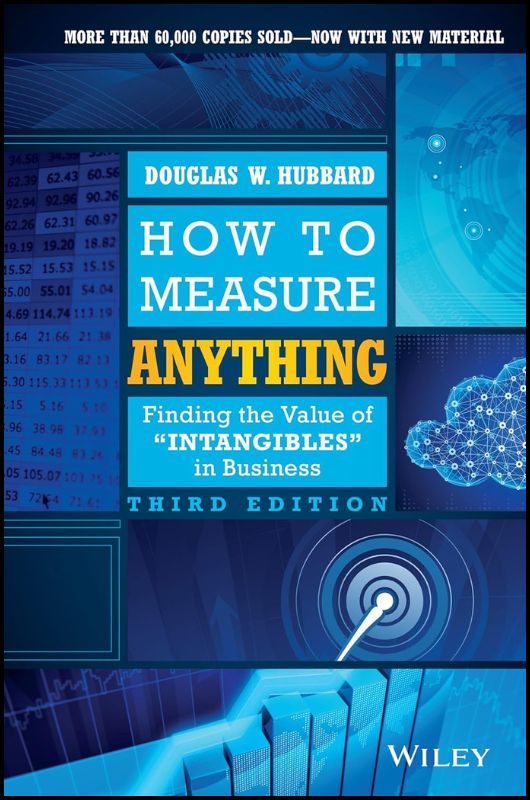
In How to Measure Anything: Finding the Value of Intangibles in Business, Douglas W. Hubbard conclusively debunks the myth of immeasurables and goes on to demonstrate that measuring intangibles is within our reach.
- Book: How to Measure Anything: Finding the Value of Intangibles in Business
- Author: Douglas W. Hubbard
- Publisher: Wiley, Third Edition, 2014
This post contains affiliate links. If you purchase through these links, we may earn a commission at no extra cost to you. Doing so supports this website and our ability to bring you these book reviews and other content. We genuinely appreciate your support and take our responsibility to provide quality, honest, and human-generated content to professionals like you seriously.
What How to Measure Anything Offers: A Framework for Measuring What You Need To Know
How to Measure Anything is both an academic and a practical how-to book. Hubbard first dismantles our misconceptions about measurement, then rebuilds our understanding with practical measurement methods and techniques.
But you don’t need a Phd! He keeps the text accessible and ensures the book has layperson utility, while grounding it in decision theory, probability, and empirical observation.
Measurement for Decision-Making
Hubbard approaches measurement not as achieving perfect precision but as reducing uncertainty enough to improve decisions. This shifts the question from “How do we measure this?” to “How do we know more about this?”
That shift from collecting precise data to gaining a better understanding empowers us to become better decision-makers.
A Mindset About Measurements
How to Measure Anything transforms how we think about measurement. In it, Hubbard underscores his approach to measurement for decision-making by promoting some basic assumptions:
- The Illusion of Intangibles. If something matters for a decision, it has observable qualities. If it can be observed, it can be measured.
- Everything Has Been Measured Before. Your “unique” measurement challenge isn’t unique.
- You Have More Data Than You Think. Organizations sit on relevant information they don’t recognize or use effectively.
- You Need Less Data Than You Think. Small samples can reduce uncertainty enough to improve most decisions.
- Useful Data Is More Accessible Than You Think. Creative measurement methods exist beyond surveys and focus groups.
This mindset is on full display throughout the book. You will see it time and again as Hubbard walks us through a structured framework for decision-analysis based on qualified quantitative information.
A 5 Step Decision-Analysis Framework for Better Outcomes
Hubbard established a 5-step decision-analysis framework that underlies How To Measure Anything.
- Define the decision-problem. First, be clear about the decision-problem at hand.
- Determine what you know now. Knowing what you know now is essential to understanding what you don’t know.
- Evaluate the value of additional information. You only need to know enough of the right things.
- Select the right measurement methods for your high-value information needs. Measuring takes time and effort, and excessive measurement can undermine efficient decision-making.
- Make a decision and act on it. An optimal decision is a reflection of the decision-maker’s risk appetite.
Each step of this decision-analysis framework is covered thoroughly in one or more dedicated chapters that explains the concept, makes it actionable, and illustrates it with real-world examples.
The data-driven approach Hubbard promotes here compliments the systematic problem-solving methods in Getting It Done, giving leaders empirical foundations for collaborative decisions.
Why How to Measure Anything Matters for Today’s Leaders
Organizations face pressure to quantify everything from digital transformation ROI to employee engagement impact. Yet, we struggle with the intangibles in business decisions despite having access to more data than ever.
How to Measure Anything provides an accessible framework for decision-analysis to bridge that gap, with practical methods for measuring intangibles, such that leaders and organizations can achieve better-informed decisions for better outcomes.
Key Measurement Strategies and Methods
Measurement Techniques Made Practical
How to Measure Anything makes “complex” methods accessible and useful for all of us. While they can be highly sophisticated, they don’t have to be, including:
- Calibrated estimates that turn subjective judgment into reliable probabilities
- Monte Carlo simulations for modeling uncertainty and risk
- Economic value of information calculations to determine what’s worth measuring
- Rule of Five for rapid uncertainty reduction with small samples
- Bayesian updating to refine estimates as new data emerges
Hubbard provides us with practical guidance so we can apply these measurement techniques ourselves to our own real business problems.
Calibrated Probability Assessments
We trust our gut. But Hubbard’s research shows that while we may have 90% confidence in our intuition, we are lucky if it’s good 50% of the time.
How to Measure Anything provides specific instructions on how to improve our intuition with calibration exercises. Once calibrated, subjective estimates become reliable probability ranges we can use in decision analysis.
In my own practice, I’ve found that this transforms how teams discuss uncertainty. Instead of debating whether something is “likely” or “possible,” we express our uncertainty as probability ranges, creating new creative opportunities to solutions.
The Economic Value of Information
We all recognize that sometimes the effort or cost of measuring something is too high; the juice isn’t worth the squeeze. So we measure what we can. But what really goes into making that call?
Hubbard shows us how to calculate the economic value of information so we can actually see how much a measurement could improve our decision.
What this reveals can be surprising. The metrics we are tracking may have little decision value, while we overlook data that could dramatically improve our outcomes. What we discover is too often we expend resources measuring the wrong things.
The Rule of Five
We often think larger sampling sizes are necessary to have assurance in the indicators they provide. But Hubbard shows us we only need enough information that sufficiently reduces uncertainty to make better decisions.
We learn in How to Measure Anything that a random sampling size of just 5 will often provide enough assurance as to the average value range, that your level of uncertainty on the subject is reduced sufficiently to make a better informed decision for the next step forward.
What How to Measure Anything Doesn’t Cover
How to Measure Anything is instructional and actionable. But if your goal is to master these concepts and practices as a speciality skill set, you will need more formal resources.
The good news is, as soon as the first edition of this book was published, universities adapted it to teach their courses. Hubbard and his publisher recognized this and made additional resources available, such as workbooks and power tools, which they tell you more about in the book.
Further, while this book is a practical resource, it is not an index or compendium of measurement problems and solutions. Rather, by showing us how to measure anything, Hubbard gives us the skills to solve our specific challenges in our specific context.
Conclusion: Transform Your Approach to Business Decisions
Douglas W. Hubbard delivers a rigorous yet practical book for one of business’s most persistent challenges: quantifying what seems immeasurable. How to Measure Anything doesn’t oversimplify. It respects the complexity of measurement while making it accessible.
What sets this book apart is Hubbard’s ability to bring our toughest measurement challenges within our reach. He makes it possible to leverage real data where we could only rely on our intuition before.
Who Should Read How to Measure Anything?
Anyone making decisions will benefit from this book: the executive evaluating strategic initiatives without clear metrics, the program manager defending budgets for “soft” outcomes, the analyst asked to quantify the benefit of an agile transformation initiative, and the consultant facing clients with “that can’t be measured” objections.
It’s equally valuable for technical professionals who understand statistics but struggle with business intangibles, and for business leaders seeking more data-driven foundations to their decision-analysis.
Bottom Line: Essential Skills for Data-Driven Decision-Making
How to Measure Anything is recommended for professionals who want to move beyond intuition and best-guess decision-making. It provides practical measurement techniques that work across contexts, delivering better decisions and defensible rationales.
This isn’t a quick-read management book. It requires engagement with quantitative concepts and a willingness to challenge assumptions about what’s measurable. For leaders committed to evidence-based decision-making, it’s an invaluable resource that pays dividends across every subsequent business decision.
This post contains affiliate links. If you purchase through these links, we may earn a commission at no extra cost to you. Doing so supports this website and our ability to bring you these book reviews and other content. We genuinely appreciate your support and take our responsibility to provide quality, honest, and human-generated content to professionals like you seriously.
About the Author: Douglas W. Hubbard
Douglas W. Hubbard is an internationally recognized expert in decision analysis, measurement, and risk management. As founder of Hubbard Decision Research, he has applied quantitative methods to major decisions across industries, including government, military, healthcare, and technology.
Hubbard’s work challenges conventional wisdom about measurement and has influenced how organizations approach decision-making under uncertainty. Beyond How to Measure Anything, he has authored The Failure of Risk Management and How to Measure Anything in Cybersecurity Risk, extending his measurement methodology to specialized domains.
Explore additional content where we bring a modern understanding of Work Management into the 21st Century: