

How To Choose A Work Management Method to Drive Your Productivity

A Context-Aware Approach to Work Management
We typically understand work management as a defined system, process, or methodology. With this fixed perspective, we often have a singular mindset of either (a) we are an X method company and we all follow the same method, or (b) if work type A, then work management method type X. The fact is, work management is all about context and fit.
In these articles, we debunked common misconceptions about work management and explained its true essence. Here we will show you how to choose a work management method that is right for you and for your work. After all…
Work management is a tool that should serve you, not a predetermined methodology you should conform to. – Jim McCrosky | MKR Center
Indeed, while conventional wisdom encourages managers to adopt defined, standardized methods, H. Wells of the University of Hertfordshire Business School reveals in his 2012 studies that 47.9% of project managers did not achieve expected outcomes from applying standardized methodologies. When we force work into prescriptive frameworks without understanding the individual context and needs of our work, we risk becoming a frustrated slave to the framework rather than the successful master of our work.
In this guide, we will introduce you to a context-aware framework for how to choose a work management method that is right for your needs. By critically assessing your work context across five dimensions, you will objectively reveal what your work actually needs from work management. With this clarity, you can select or construct an approach to managing your work that meets you where you are and adapts with you as your work’s context and needs evolve.
Explore work management methods by matching work context to methodology in this Guide to Work Management Methods And How They’re Best Used.
How to Choose a Work Management Method – Context Matters
Context matters. And the context of your work should be the driver for determining how to manage it. Because it is from context that you can objectively determine what your work needs to be effectively managed. Importantly, it is the context that forms the foundation for how to choose a work management method that works for you!
There are five dimensions for understanding the context of your work.
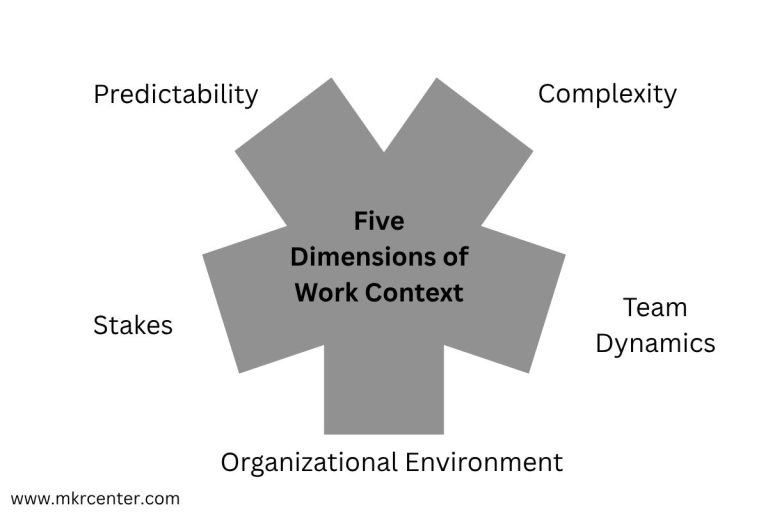
The Five Dimensions of Work Context
Predictability examines the spectrum from fully known to fully emergent requirements: how much is known in advance versus how much will be discovered during execution. High predictability means requirements are clear, stable, and unlikely to change—think regulatory compliance projects or manufacturing processes. Low predictability means requirements emerge through exploration and feedback—like developing a new product for an uncertain market or solving a unique technical problem.
Complexity evaluates the web of interdependencies, stakeholder networks, and technical challenges your work involves: how many interconnected parts must align, how many stakeholders must coordinate, and how intricate are technical or logistical challenges. A simple project might involve a small team working independently with clear technical paths. A complex project could involve multiple teams across departments, external partners, challenging technical integrations, and competing stakeholder interests.
Stakes assess the consequences of failure, delays, or quality issues. Are the consequences missed revenue, regulatory penalties, safety risks, reputational damage? High-stakes work demands rigorous validation, quality controls, and risk management. Low-stakes work can tolerate more experimentation and learning through doing.
Team Dynamics examines the human factors that shape how work happens: team size, geographic distribution, experience levels, working relationships, and cultural norms around autonomy and decision-making. A small, co-located team of experienced professionals operates very differently from a large, distributed team of varied skill levels. Has the team worked together before, are they in the same location or across time zones, does the organizational culture support self-organization or require more directive management?
Organizational Environment considers the broader context in which your work exists: available resources, decision-making authority, organizational constraints, existing systems and processes, and cultural readiness for different approaches. Consider flexibility in budgeting, access to necessary tools and expertise, approval processes, compliance requirements, and how much autonomy the team actually has. Even the best methodology won’t work if the organizational environment can’t support it.
Making an Objective Assessment
The value of this framework depends entirely on being objective. It can’t be about what you wish were true about your work, about the future state of your team growth goals, or biased by the methodology you want. The context-aware framework will inform you on what your work needs. You then get the opportunity to ensure which ever approach you choose for managing your work is implemented to meet your work’s needs.
Gather input from multiple perspectives. Engage your team, stakeholders, and others experienced in your particular work. Use evidence from past similar work. How stable were requirements on the last project of this type? How many coordination challenges actually emerged? What were the real consequences when things went wrong?
As management scholar Henry Mintzberg observed, “Management is, above all, a practice where art, science and craft meet.” This applies to your work context assessment — it requires empirical observation (science), intuitive understanding (art), and practical experience (craft). The framework provides structure, but your judgment makes it accurate.
Work Clarity: The 5 Management Dimensions of Effective Organizations
Reading Your Work’s Context Profile – What It Reveals
Once you’ve assessed your work across the five dimensions, patterns emerge that guide you on how to choose a work management method that satisfies what your work actually needs. It’s important to see the full picture because each dimension interacts with each other dimension, creating the context. No one dimension is determinative, it’s just a point of information – that isn’t context!
Interpreting Patterns Across Dimensions
The power of context assessment lies in pattern recognition. “High complexity” means something very different when paired with high predictability versus low predictability. When requirements are clear and interdependencies are manageable, you may be looking for streamlined processes that maximize throughput and minimize waste.
Conversely, if requirements will emerge through experimentation and multiple moving parts must coordinate amid uncertainty, you may be looking for frequent feedback loops and mechanisms for easily adjusting course.
Distributed teams may need asynchronous communication protocols and more explicit documentation practices than co-located teams might. Inexperienced teams may benefit from more structure and guidance, while veteran teams may thrive with greater autonomy.
I’ve learned to calibrate methodology selection not just to work characteristics, but also to what the organization can realistically support. An adaptive approach leveraging rapid decision-making may struggle in a context where more operational control is vested in the hierarchy.
And certainly, high stakes changes the equation regardless of other factors. When consequences of failure are significant—whether safety risks, regulatory penalties, or financial losses—you’ll probably want to leverage additional checkpoints, review cycles, and quality assurance mechanisms, even when other dimensions might suggest lighter-weight approaches.
Understanding Needs, Not Methods
Here’s the critical distinction: your context profile points to needs, not methods. When I see high complexity and distributed teams, I don’t assume a particular method. Instead, I recognize this context needs strong coordination mechanisms and transparent communication systems. Those needs might be addressed through elements from Stage Gate, Scrum, Kanban, or other methodologies.
You’ll need the full five-dimensional picture to get the context that tells you which problems to solve; methods are the tools for solving them. The context will show you how to choose a work management method that helps you make your work work.
From Context to Needs – Identifying What Your Work Requires
The shift from asking “what method should I use?” to “what does my work need?” represents a fundamental change in thinking. I’ve found this reframing prevents the most common mistake in methodology selection: forcing work into pre-selected frameworks rather than building approaches that address actual needs.
Your work’s context profile reveals specific needs. These needs are the bridge between understanding your work situation and selecting the right elements to manage it effectively. You’ll see that your work’s needs will emerge from this context assessment into seven core themes.
What Context Reveals About Work Needs
| Work Needs Theme | What It Addresses | Context Drivers |
|---|---|---|
| Coordination Mechanisms | Managing complexity and interdependencies | Complexity, Team, Environment |
| Adaptation Capabilities | Responding to uncertainty and change | Predictability, Stakes |
| Validation & Quality Controls | Protecting against risk and ensuring quality | Stakes, Complexity |
| Planning & Visibility Structures | Creating alignment and making progress visible | Predictability, Complexity |
| Learning & Improvement Cycles | Building team capability over time | Team, Environment |
| Communication & Transparency Systems | Keeping stakeholders informed and aligned | Complexity, Team, Environment |
| Decision & Governance Frameworks | Defining authority and managing approvals | Environment, Stakes, Complexity |
The Seven Core Work Needs Themes
Coordination mechanisms address complexity and interdependencies. When multiple teams, systems, or stakeholders must align, you need deliberate coordination structures. High complexity demands robust coordination—dependency mapping, integration points, synchronization rituals, and clear handoff protocols. We’ve all seen projects struggle not from poor individual work, but from inadequate coordination when that work must come together.
Adaptation capabilities respond to uncertainty and change. When requirements emerge through discovery rather than specification, you need mechanisms that facilitate rapid adjustment. Low predictability contexts require iterative cycles, feedback loops, decision frameworks that enable quick pivots, and permission structures that allow teams to respond without extensive approvals.
Validation and quality controls protect against risks in high-stakes work. When failure carries significant consequences, you need checkpoints, review cycles, testing protocols, and verification mechanisms built into your approach. The cost of inadequate validation far exceeds any efficiency gains from skipping it.
Planning and visibility structures create alignment around work scope and progress. Predictable work benefits from detailed roadmaps and milestone tracking, while unpredictable work benefits from progressive and participatory planning.
Learning and improvement cycles build team capability over time. All work benefits from reflection, but how much, when, and in what form vary by context.
Communication and transparency systems ensure stakeholders stay informed and aligned. Distributed teams need more explicit communication protocols than co-located teams. Complex stakeholder networks require more sophisticated communication structures than simple ones. Design communication systems based on who needs what information, when, and in what format.
Decision and governance frameworks define authority and approval processes. Highly regulated environments may require more formal governance than autonomous environments. Identify required decision points and clear decision authorities.
Selecting Work Management Methods That Address Your Needs
You may be able to align your work’s needs to one or more work management methods that work well as designed. But it may be that your work profile might not be a simple round peg matched to a simple round hole. That’s ok, embrace it…
Every work management methodology comprises individual elements: practices, techniques, artifacts, and rituals. When you recognize this, you gain access to a rich library of proven elements you can select based on your actual needs, rather than being locked into a methodology. Ask “which specific elements from any methodology relate respectively to my work’s various needs?”
Work Management Fundamentals: The 7 Essential Building Blocks for Success
Matching Elements to Work Needs
For coordination needs, look to elements that manage complexity and interdependencies. Kanban boards provide visual workflow management. Dependency mapping reveals critical relationships between work items. Integration points define where separate work streams must align. Daily standups maintain synchronization across team members. Scrum of Scrums coordinates multiple teams. The specific coordination elements your work needs depend on its level of complexity—simple coordination might require only a shared board, while complex interdependencies may require multiple coordinating mechanisms.
For adaptation needs, consider iterative elements. Sprint cycles create regular delivery and feedback cadences. Retrospectives build continuous improvement into your rhythm. Continuous feedback loops from users or stakeholders inform direction changes. Timeboxing forces prioritization and prevents endless refinement. Rolling-wave planning details near-term work while keeping distant plans flexible. Select adaptation elements based on how much uncertainty you’re managing—higher uncertainty demands more frequent feedback and adjustment cycles.
For validation needs, quality control elements help mitigate risk. Stage gates establish formal review points before proceeding. Testing protocols ensure deliverables meet requirements. Review cycles catch issues early. Acceptance criteria define clear success standards. Earned value management tracks performance objectively. High-stakes work requires multiple validation layers;